None
EN
NASA's Webb Telescope Captures Stunning New Images Of The Lion Nebula's Glowing Cosmic Mane
['Jerry Thompson']
International Business Times Australia
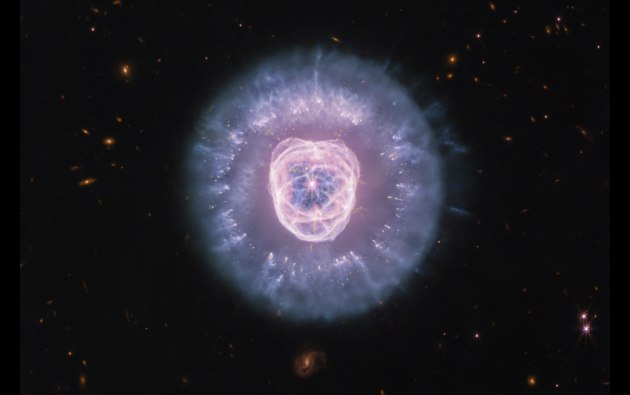
NASA's James Webb Space Telescope has captured striking new images of a dying star's remains, revealing unprecedented detail in a cosmic structure nicknamed the Lion Nebula for its uncanny resemblance to a lion's face framed by a glowing mane.
Toward the mane's outer edges, purple, cometary-shaped clumps of dust are visible, structures that have managed to survive the dying star's radiation rather than being destroyed outright.
Researchers have observed similar self-shielding dust structures, known as cometary knots, in other planetary nebulae studied by Webb, including the Helix Nebula, images of which NASA released in January.
Scientists estimate that the structure captured in Webb's new images represents a relatively brief snapshot in the nebula's ongoing evolution.
The new Lion Nebula images were processed by Alyssa Pagan of the Space Telescope Science Institute, using data collected under proposal 9548, led by principal investigator M. Garcia Marin.