None
ES
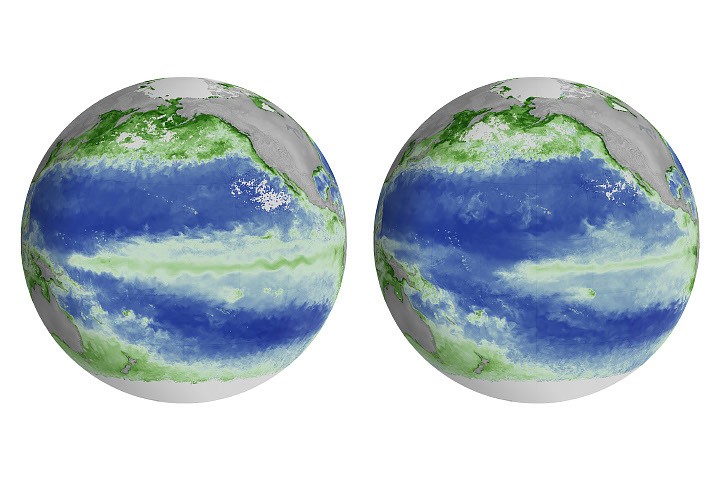
El Niño Alters Marine Life in the Pacific
[]
NASA Science
As of June 2026, El Niño has officially arrived.
As the El Niño progresses, the scientists anticipate the differences in the central Pacific will become more pronounced.
Although the disruptions to marine life can be severe, a post-El Niño “chlorophyll rebound,” with higher-than-normal concentrations in the equatorial Pacific, can occur.
“The scientific community will be able to observe the 2026 El Niño with data across more wavelengths of light than ever before,” Kehrli and Trolley said.
PACE’s sensors can measure plant pigment composition on land and clouds and aerosols in the atmosphere, all of which are influenced by El Niño.