None
EN
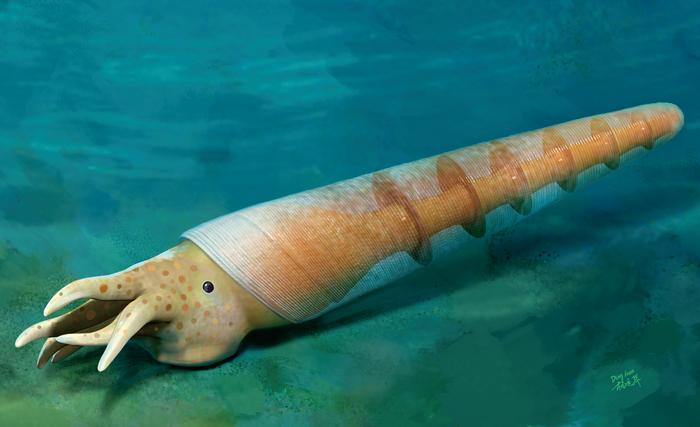
Eoceras shaanxiense: Early Cambrian fossil discovery sheds light on evolution research
['Emily Warrender', 'Please Enter Your Name Here']
Open Access Government
An international research team discovered Eoceras shaanxiense, a 520 million-year-old fossil in South China.
However, genetic molecular clocks indicated that cephalopods diverged much earlier during the early Cambrian Explosion.
Sealed segmented siphuncle: The evolution of a rudimentary, segmented tube (as seen in Eoceras) allowed basic fluid and gas exchange across chambers.
Advanced buoyancy control: Cephalopods subsequently developed complex, true siphuncles featuring formal septal necks and connecting rings, enabling active swimming and neutral buoyancy.
While Eoceras clarifies the structural origin of the cephalopod shell, the authors note that further early Cambrian discoveries will be necessary to reconstruct the soft-body anatomy of these ancient marine organisms.