None
EN
Aguirre, the Wrath of God: real history and Herzog’s otherworldly allegory of empire
['Nathalie Morris', 'Lisa Kerrigan', 'Brogan Morris']
BFI | Features and reviews
Werner Herzog’s Aguirre is a fevered descent into madness and myth, where colonial ambition meets cosmic futility.
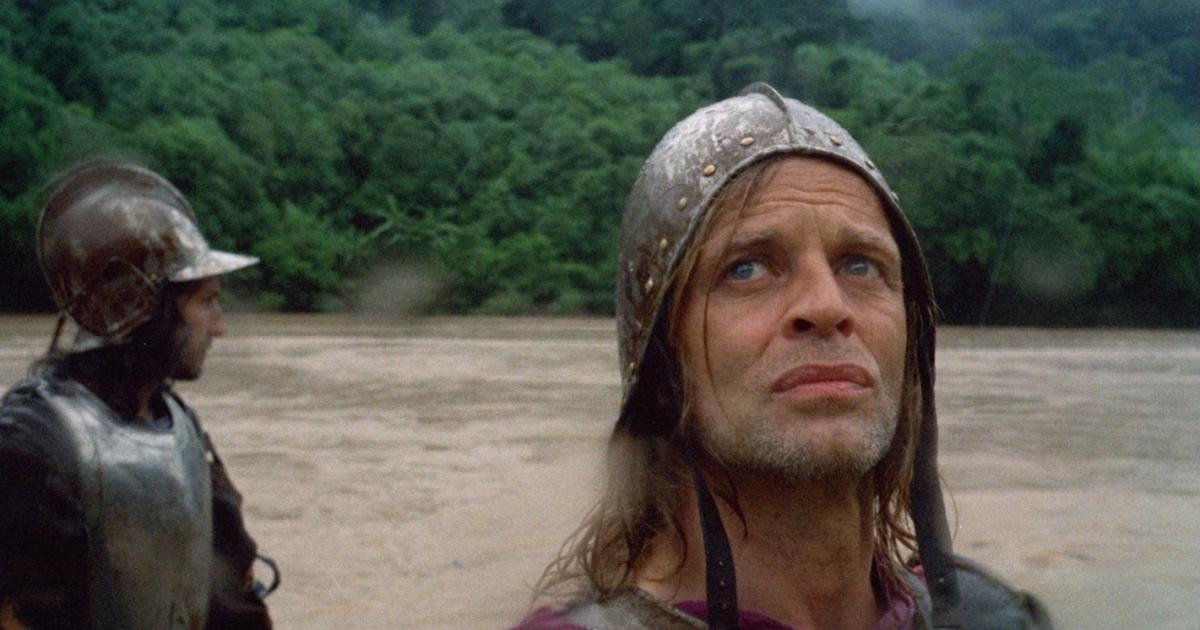
A pinnacle of the New German Cinema movement, Werner Herzog’s hypnotic third feature Aguirre, the Wrath of God (1972) is a film of extremes about extreme actions.
At the end of Herzog’s film, Aguirre, alive on the raft, stands at the centre of a visual vortex achieved by the camera mounted on a motorboat that whirls dizzyingly around him: the circle of death.
Aguirre, the Wrath of God (1972)Clouds hang over the foreboding Andes, its peaks stretching for miles beyond the foregrounded mountain.
Insane though Herzog’s Aguirre is, he understands how history becomes history through theatricalised ceremonies and proclamations, however flimsy the pretexts for manipulating them to allocate power.
['empire'
'ursúa'
'real'
'spanish'
'amazon'
'otherworldly'
'history'
'pizarro'
'aguirre'
'god'
'film'
'allegory'
'wrath'
'herzog'
'herzogs']