None
DE
iFlytek chair delivers confident speech to employees despite projected net profit fall of over 70% for 2023
['Cheyenne Dong', 'More Cheyenne Dong', '.Wp-Block-Co-Authors-Plus-Coauthors.Is-Layout-Flow', 'Class', 'Wp-Block-Co-Authors-Plus', 'Display Inline', '.Wp-Block-Co-Authors-Plus-Avatar', 'Where Img', 'Height Auto Max-Width', 'Vertical-Align Bottom .Wp-Block-Co-Authors-Plus-Coauthors.Is-Layout-Flow .Wp-Block-Co-Authors-Plus-Avatar']
TechNode
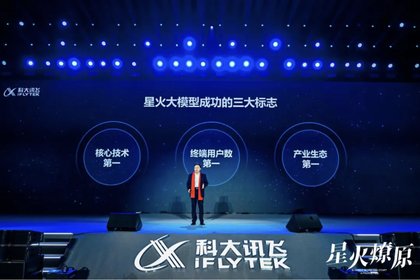
Chair of iFlytek Liu Qingfeng told employees that the Chinese voice-recognition company has “resisted the extreme pressure from the US” and is entering “a new period of strategic opportunity,” at his firm’s annual general meeting.
Speaking on Tuesday, Liu again benchmarked iFlytek’s upgraded Spark against GPT-4 Turbo, saying it expects to be as powerful as OpenAI’s most advanced model in the first half of 2024.
Liu’s address on Tuesday emphasized the importance of building “independent and controllable” home-grown AI foundation models, with the exec saying LLMs are a battlefield for gaining strategic advantage over the US.
However, the company’s financial forecast offers a glimpse into the huge cost of achieving China’s ChatGPT alternative, with iFlytek’s net profit excluding extraordinary profit and loss expected to be down 71% to 81% to between RMB 80 million and RMB 120 million ($11.3 million to $16.9 million) in 2023 compared to the previous year iFlytek has claimed this is largely due to “firm investment” in core technology and industrial chain localization substitution.
Context: The US government blacklisted A-share listed iFlytek in Oct. 2019, meaning China’s top artificial intelligence company was banned from buying critical components from US companies without US government approval.
['delivers'
'company'
'fall'
'rmb'
'despite'
'speech'
'projected'
'million'
'net'
'liu'
'model'
'ai'
'chinese'
'technode'
'profit'
'employees'
'iflytek'
'strategic']