None
EN
Webb Telescope Discovers Ancient Galaxy That Challenges Theories On Early Universe
['Lydia Amazouz']
The Daily Galaxy –Great Discoveries Channel
NASA’s James Webb Space Telescope has once again redefined the boundaries of cosmic observation.
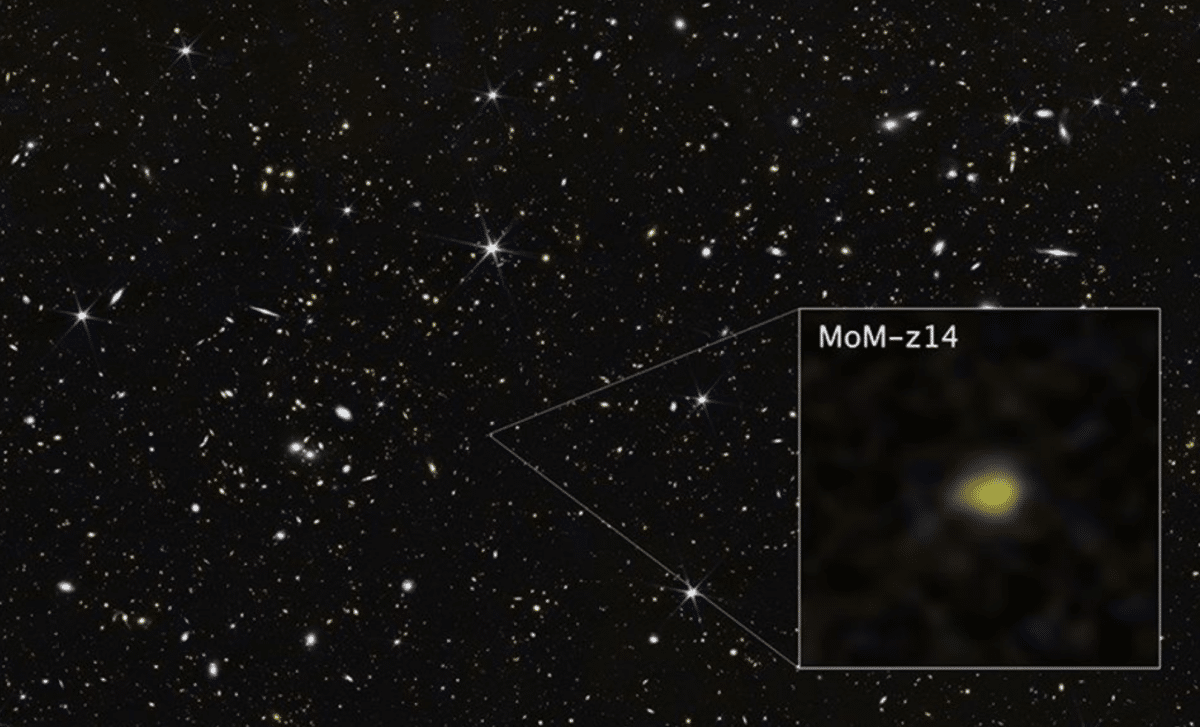
A recent study published via NASA Science confirmed the detection of galaxy MoM-z14, an unexpectedly bright and chemically rich galaxy that existed just 280 million years after the Big Bang.
NASA’s James Webb Space Telescope shows galaxy MoM-z14 as it appeared in the distant past, only 280 million years after the universe began in the big bang.
The implications of this are profound: our models of early galaxy formation may be missing critical elements, particularly regarding the timeline of star birth and chemical enrichment.
Its existence suggests the early universe may have birthed supermassive stars capable of rapidly creating heavier elements.